
Expertise Asia has posted almost 1,000 articles over the past 5 years. Interested readers have the option to contribute to the publication, as an acknowledgment of the value provided to them. Contributions do not commit the author to future production. Thank you for your continued support.
Share


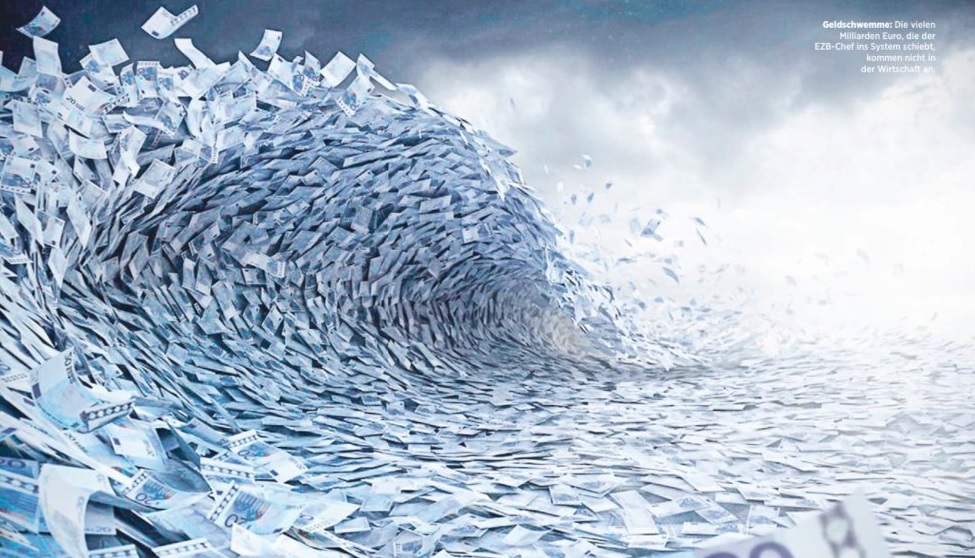
When is anyone going to restrain the workings of the European Central Bank? In fact, can anyone do it, and who would that be? All I know is that the Bundesbank’s Jens Weidmann votes against all those ECB resolutions of widening the monetary base and has never been in a position to fight the prevailing majority. Every time one looks at the latest reports of the Public Sector Purchase Programme, one cannot help but pulling his hair out.
It so happened again late last week, when numbers for the week of 27 January were released. Within the said program, which was commenced on 13 March last year, the eurosystem has so far purchased eurozone government bonds in the secondary markets to the tunes of 1.32 trillion Euros – in less than one year! The increase has been very steady, and from the previous week another 16.9 billion worth of paper were added.
Literally against its will, the Bundesbank is having to participate according to the distribution key based on each central bank’s capital contribution. It has bought around 304 billion of German Bunds by the end of 2016, and in total 18% of all purchases. Weidmann alone will never be able to oppose the will of Mario Draghi and the council members of predominantly ailing periphery nations that desperately need the printing press to stay alive financially.
For the German economy however, this is absolute nonsense. Buying up Bunds constitutes a stimulus the economy does not need at all. On the contrary, it furthers the creation of bubbles in asset prices. By way of euro membership though Germany simply owes to the weak eurozone countries that it keeps playing ball, even to its own disadvantage. Else, what good is a government bond curve to be if most of it trades in negative yield territory?
But it’s not only government bond prices that are being distorted. The ECB resolution also includes the purchases of corporate bonds, commenced on 10 June of last year. Hence, during an even shorter time period a total of 58.8 billion Euros worth of paper issued by private enterprises have been soaked up by the eurosystem. Considering the European corporate market encompasses 575 billion more than 10% of which are now owned by the taxpayer.
To be sure, the ECB is trying to be mindful of the credit risk they hold on their balance sheet, even though you better not watch out for other holdings such as the Greek bonds bought 5 years ago. However, the market for double A and single A-rated bonds isn’t deep enough for Draghi’s ambitions. If you scan through the list of bonds acquired, you will find a large portion of BBB+ rated instruments, and you even come across various titles rated BBB-.
Apart from the manipulation of asset prices, which has long made it impossible to keep talking about a market-based system, it is very feasible that one or the other company gets downgraded while their debt is being held by the ECB. One wonders what Draghi will do if those were to slip into high yield category. Sell, into an illiquid market at a substantial loss? Go explain that to the taxpayer.
The ECB report also revealed the current state of its very own ECB deposits by commercial banks, those that were meant to be averted by introducing a punishing deposit rate of -0.4%. Guess what, deposits are still on the rise, steeply. The unprecedented flooding of banks with excess central bank liquidity has literally had only one effect, namely that those banks don’t know any better than shifting it back to the ECB, even at a loss to them.
Whether he likes it or not, Mario Draghi is responsible for 1.386 trillion Euros of deposits at his own shop – that is without the minimum reserves banks have to keep with the ECB anyway – money that no one in the eurozone needs, neither the banks nor the economy as there is no demand for it, and therefore solely constitutes another burden on the banking system. When will the lunacy end, and who will be able to stop it?
All this has the very well and widely known effect of the Euro being weak against the dollar, something the new man in charge of trade at the Trump administration, Peter Navarro, has recently held against Germany in particular, in his words accusing Berlin to use the grossly undervalued currency to create a vast trade surplus. He obviously isn’t wrong, but he should rather have decried Germany’s unwillingness to spend instead.
What Navarro has achieved however is that no lesser man than Wolfgang Schaeuble immediately rebutted that Germany was in no position to influence the Euro’s exchange rate, and that it was the ECB’s fault by carrying on with quantitative easing, something that his teutonic camp was opposed to in any case. So the finger pointing has begun, but it’s hard to believe that Trump’s attention will be diverted to the ECB instead.
Share
The postings on this website are confidential and private. The material is provided to you solely for informational purposes and as a complimentary service for your convenience, and is believed to be accurate, but is not guaranteed or warranted by the author. It has not been reviewed, approved or endorsed by any financial institution or regulatory authority in your jurisdiction. It should not in any way be construed as investment advice and/or -recommendation of any kind, in any market and in any jurisdiction. The views expressed therein are none other than the author’s personal views. He is not responsible for any potential damages or losses arising from any use of this information. The reader agrees to these terms.